
Everett Previous Residents by Era
One Everett address leaves different kinds of Everett records in different periods. Begin with the most recent Everett parcel and deed information, then add dated Everett address sources as the trail moves backward. The table marks the actual Everett access routes and avoids turning an uneven Everett historical run into a claim of continuous coverage. Everett directory and map entries are clues for a stated year, while an Everett recorded instrument is evidence about a transfer.
| Source | Years it covers | Where held | What it shows |
|---|---|---|---|
| Everett Patriot assessment records | Current Everett fiscal-year portal | Everett Assessor | Everett parcel ID, situs, owner, land-use, sale, and book/page clues. |
| Everett Middlesex South grantor index | 1896–1973 Everett online release | Everett MassLandRecords route and Registry | Surname, Everett town, book/page lead, then the underlying recorded instrument. |
| Everett city directories | Listed Everett holdings, 1870–1940 | Massachusetts State Library; NARA Everett reference for 1928–34 | Dated Everett name, address, street sections, and volume-specific annotations. |
| Everett resident listings | Uneven Everett listed years, 1933–2013 | Everett Public Libraries / NOBLE | Everett historical listings for people age 17 and older. |
| Federal census for Everett addresses | Released schedules through 1950 | Federal and Everett library research routes | An Everett household snapshot for the census year, not a current address source. |
| Everett Sanborn map | 1955 verified Everett set | Library of Congress | Everett building footprint, use, and fire-insurance details for the mapped year. |
When an Everett search reaches a gap, record the Everett gap. The research did not establish a complete Everett citywide street-renumbering chronology, a complete Everett Sanborn year list, or a universal Everett obituary index. An Everett no-hit in one source is not proof that no person or building existed.
Everett Patriot Parcel First
The current Everett physical parcel is the starting key for past residents research. Search the Everett street number and name in Everett Patriot Properties, then retain the displayed Everett parcel ID, Everett situs location, owner of record, land-use code, assessment context, sale information, and book/page. The Everett Assessor uses the parcel and situs for assessment. That makes them more stable Everett handoffs than a name alone when an old volume uses a shortened street suffix or a different address format.
Separate Everett situs from an Everett tax mailing address. Situs is the physical Everett parcel location; the mailing field is where notices are sent and can belong to an institution, representative, or other correspondence destination. It is an Everett lead, not proof that the addressee lived at the property. Everett Patriot also treats personal-exemption applications as nonpublic, even though the public exemption record book has a narrower purpose.
For an unresolved parcel, the Assessor is at 484 Broadway, Room 11, Everett, MA 02149, 617-394-2205. Ask for a specific public field or card and a stated address/date range rather than a newly compiled resident history.
Everett Previous Residents Deed Chain
The Middlesex South Registry of Deeds holds the land-record trail for Everett. Its MassLandRecords interface offers name, document, book, property, recorded-date, and unindexed-property searches. Begin with the Patriot book/page clue and current owner, but verify the parcel through the recorded instrument’s legal description. A recorded party is not automatically every past resident, so keep the transfer date and document type in the log.
- Record the current Patriot parcel ID, situs, owner, displayed sale date, and book/page.
- In MassLandRecords, select Everett and search the likely current buyer as a grantee or name party near the sale date.
- Open the instrument or request it from the Registry, then compare its legal description, lot, plan, and parties with the parcel.
- Identify the seller on that transfer and search the seller as an earlier grantee to find the prior acquisition.
- Repeat the loop, branching for estates, trusts, corporations, foreclosures, multi-parcel transfers, or subdivisions instead of forcing a one-name sequence.
Earlier or unindexed material can require the Registry counter, staff assistance, deed books, microfilm, or a written copy request. The Registry is at 208 Cambridge Street, Cambridge, and public research hours are Monday through Friday, 8:00 a.m. to 4:00 p.m. Search/view/download access is stated as free; certified copies are a separate paid route.
Everett Previous Residents Index Bridge
The online Middlesex South grantor-index release for 1896–1973 is especially useful for a backward house trail. Search the surname and town, note the book/page reference, and retrieve the underlying deed or other instrument. An index reference is not the deed’s full terms. The release also does not prove that every pre-1896 instrument, plan, registered-land certificate, or image is searchable in the same way.
MassLandRecords also exposes unindexed-property mode for Book 1 through 1024. When the electronic index cannot resolve a transfer, compare the legal description and plans at the Registry. FamilySearch’s Massachusetts Land Records collection is an additional image lead for grants, deeds, and mortgages, with county-courthouse originals behind the collection. Keep the repository and image date with each note.
- Grantor / grantee
- The grantor transfers an interest in the instrument. The grantee receives it. A deed may have more than one party on either side.
- Chain of title
- A dated sequence of transfers tied to the same legal parcel or lot, checked instrument by instrument.
- Legal description
- The lot, plan, metes-and-bounds, or other property language in a recorded document. It is often safer than a street number for old records.
- Book and page
- The Registry citation that points from a result or index entry to the recorded instrument.
Deed research becomes less certain when the parcel splits, several parcels appear in one instrument, or a transfer passes through an estate or entity. Label those branches rather than flattening them into a single personal chronology.
Everett Previous Residents Directory Years
Directories fill some of the long spaces between transfers. The Massachusetts State Library lists Everett city-directory holdings from 1870 into 1940, and the NARA reference adds 1928–1934. Everett Public Libraries has uneven digitized resident-listing years from 1933 through 2013 for people age 17 and older. These records can place a name with an address in a given edition, but they do not establish legal ownership or every household member.
Use a dated process flow: directory year and its exact address string → nearby federal census year, subject to the 72-year release rule → deed, newspaper, probate, or map check that independently fits the address. The newest full released census in the research context is 1950. A census is a snapshot of a household in its enumeration year, not a current lookup.
Henry M. Meek’s 1908 directory has alphabetical material, street sections, business listings, and abbreviations. Open the digitized 1908 Everett Directory to inspect the edition rather than relying on a quoted name from another source.
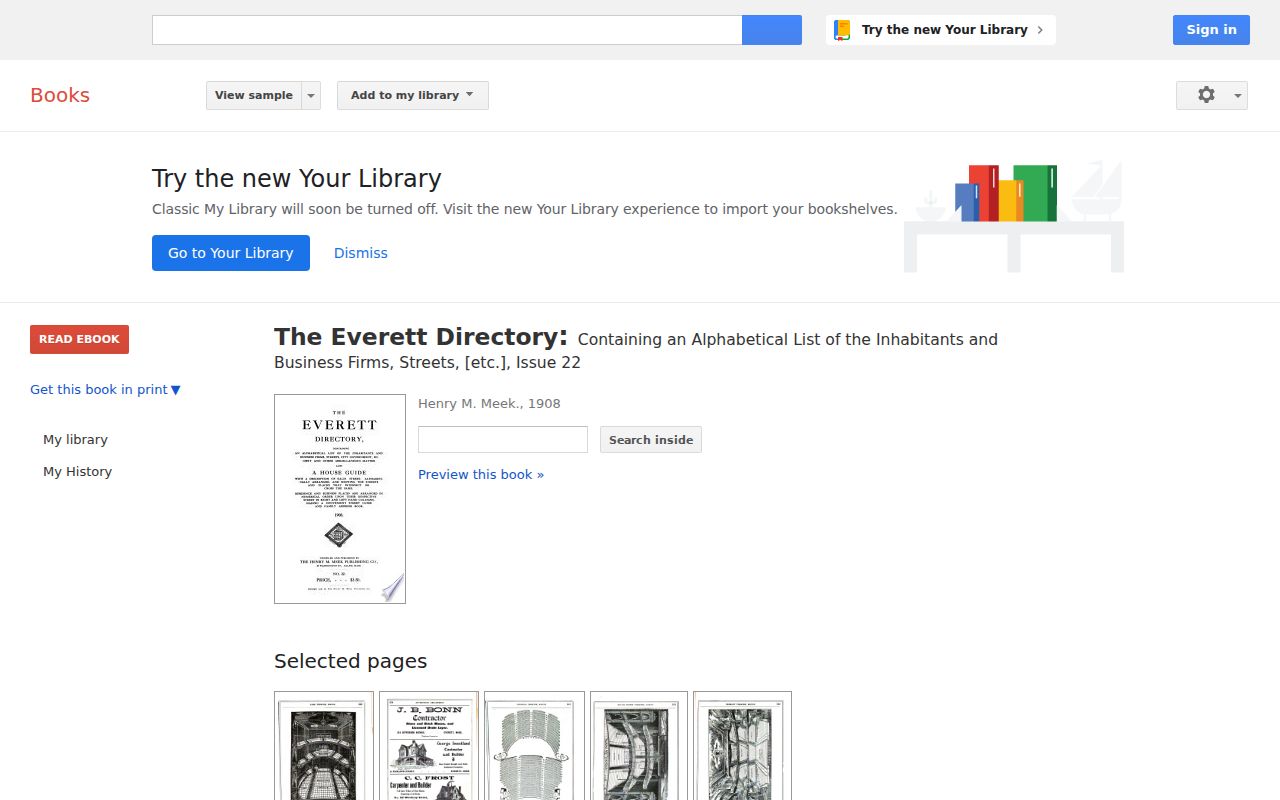
The 1908 directory is strong evidence of how that edition arranged names and streets. Its date and editorial choices still need to remain attached to every historical address clue.
Everett Previous Residents Map Context
The Library of Congress has a public-domain 1955 Everett Sanborn set comprising 78 sheets. It can establish a building footprint, mapped use, material, or fire-insurance context at the date of the sheet. It cannot establish who lived at the location. Use a map as a building check beside a deed or directory, never as a person record.
Massachusetts State Archives architectural index cards are another address-specific lead. The cards can include title or address, stories, street, use, class, owner, architect, architect address, inspector, and date. Examples in the research include cards for Main Street, Chelsea Street, Winthrop, Norwood, Broadway, and Tileston. Their selected-project coverage means a missing card is not evidence that the address had no history.
Parlin Memorial Library is the local history contact for resident listings, yearbooks, newspapers, photographs, and historic publications. Its rare and fragile materials may require advance contact at parlininfo@noblenet.org. Give the exact address, approximate construction period, prior-name clue, and year range when asking about a historical lead.
Everett Previous Residents Address Mismatches
Everett’s rapid growth after rail and streetcar service means historical sources may use building names, old formatting, or a street string that does not match a modern search. The MHC review did not establish broad renumbering or renaming evidence, and no authoritative complete chronology was located. That is a research gap, not permission to assume a modern conversion.
Place the original source address beside the normalized current form. Compare the directory page, Sanborn sheet, State Archives card, current Patriot parcel ID, and GIS location. If the conflict remains, ask the Assessor or GIS coordinator about the parcel/address relationship and preserve the unresolved discrepancy in the log.
Everett Previous Residents Probate Trail
An owner’s death or estate can explain a break in the deed chain. Middlesex Probate and Family Court South, at 10-U Commerce Way in Woburn, is the practical probate route for Everett. MassCourts and the clerk can identify the available docket or file, but images and certified copies vary by record type and access status. The state historic-probate guidance names Middlesex indexes and off-site file handoffs as further routes.
For obituary context, no authoritative Everett-wide index was confirmed. Parlin’s historical-publications route includes searchable or browsable Everett Leader-Herald and Everett News-Gazette issues from 1940–1959. A newspaper notice can supply a lead about a relationship or address, but it may be incomplete or family-supplied. Confirm it with probate, a directory, deed, or city record.
Everett Previous Residents Limits
A backward address trail can show different relationships to the same place. A deed identifies parties to a transfer. Patriot identifies an owner of record for assessment. A directory or resident listing can show a dated listing. A census records a household at its enumeration point. None alone proves every person connected with an address or a continuous timeline between dated records.
Keep a source log with the record type, date, page or book reference, custodian, and any uncertainty. That is more useful than merging same-name results into a single story.